
Pages Menu
TwitterRssFacebook
Categories Menu

Posted on Feb 19, 2013 in blogosphere, gender, philosophy, respect | 18 comments

Negative criticism and the internet
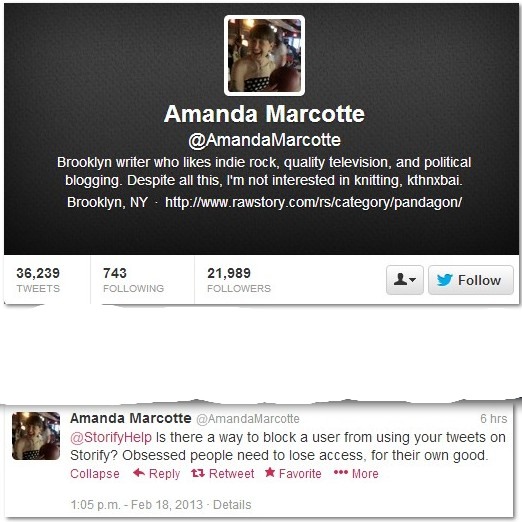
Amanda Marcotte, a writer for Raw Story and quite a popular figure on Twitter, recently asked Storify — a public archiving service which archives public tweets — if there is a way to block a user from archiving her tweets. She further suggested that people “need to lose access” “for their own good.”

I don’t believe Marcotte has the moral right to suggest that people refrain from archiving her publicly available tweets through a publicly available archiving service. If she wants to publicly share her views through a public social networking service like Twitter, she has no moral right to demand that Storify (which hosts her tweets) or individuals (who archive her tweets) refrain from archiving her public content.

The recent behavior of Marcotte provides a great springboard from which to further elaborate on my views concerning individuals publicly sharing information on the internet and the feedback they receive. This piece will explore the nature of the internet, discuss the consequences of sharing controversial views, provide tips for individuals who do not deal well with criticism, and suggest measures people can take to reduce negative feedback.

Writers who release content on public social networks should understand that favorable feedback, negative feedback, criticism, satire, parody, ridicule, and — at the very least — commenting will often follow the release of content – especially content of a controversial nature. Some will face negative criticism more than others for a variety of reasons — perhaps depending on the tone one sets with their shared content (respectful posts may garner respectful commenters while posts filled with invective may attract negative feedback and nasty commenters) — while others may not face negative criticism at all.

Individuals who do not deal well with conflict or challenge, I must note, as I had on many occasions, should consider refraining from making their opinions public. Rather than attaching a ‘real life’ face and name with publicly available information, such individuals may prefer to post anonymously, contribute to others’ work [anonymously], or completely disengage from the ‘wild world’ that is the internet.

I have little sympathy, then, for individuals who do not deal well with conflict and not only make their content public with a ‘real life’ name and face, but also continually directly or indirectly engage with their detractors. If the internet experience is really so damaging to these individuals, they should disengage or contribute in other ways. Those who continue to engage, and have seen negative outcomes in the past, seem to be behaving foolishly. They want and love the public platform which is tied to negative criticism but complain when negative criticism arrives through the public platform. One cannot , in many cases, experience all of the desired outcomes and uses of the internet will completely being shielded from the detrimental outcomes when releasing public information.

It may be nice to simply snap our fingers and soothe the emotions of all ‘mean people’ on the internet. It may be nice if writers could be immune from the ‘mean people.’ This, though, is not a reality. Those who share controversial opinions on the internet — regardless of their philosophical leanings or demographics — will often face harsh criticism. A desire to purge the internet of nastiness, then, is a futile ambition and a losing battle.

On the other hand, facing criticism — even if the persons offering it are mean-spirited — can be beneficial in many ways. Living life entirely as a ‘safe space’ in which no dissent is tolerated or is automatically viewed as intolerant, hateful, or bigoted (no matter how respectful the criticism is) provides little to no room for self-reflection, growth, or modification of beliefs. Detractors who may get ‘under our skin’ can, after all, motivate us to reconsider our ideas and improve our capacity to defend beliefs.

Failure to engage with our detractors can be an intellectual vice — and even many betray a “sign of insufficient concern for truth” — as Roberts and Wood explain in their book Intellectual Virtues: An Essay in Regulative Epistemology:

One sign of insufficient concern for truth is that when such people are given an opportunity to test their more cherished beliefs, they decline it, or apply it too casually, or offer defenses of the beliefs that are weaker than any that these people would accept in other contexts.

Of course not all offering criticism are doing so in good faith with an aim to further discussion or help others arrive at truth. Some cases, then, call for one to ignore dissent, block some individuals, and not tolerate invective. This attitude, though, should not be globally applied; not all dissenters are horrible people who ought to be blocked, ignored, and blacklisted. Individuals should avoid believing that all who dissent do so with bad intention. The block, ban, and blacklist approach, too, should be used sparingly and only in extreme situations.

How, then, ought one act in response to the nature of the internet and dissent – both good and bad?

Writers who share their opinions on the internet, I think, should not focus on bemoaning the medium by which they want to promote themselves and their ideas. Rather than rebuking the internet (or its users), one should seriously consider refraining from internet use if they have so many problems with it and others who use it.

For those who wish to remain on the internet and express their controversial opinions even though they may not handle conflict or criticism well…steps can be taken to reduce the negative feedback:

  • Do not directly or indirectly engage with dissenters.
  • Avoid commenting on websites of your ideological opponents.
  • Refrain from attacking individuals; stick to criticism of ideas rather than persons.
  • Consider how people might respond to what you write. Can something be reframed so as to not lead to undesirable criticism?
  • Avoid sharing content when experiencing heightened emotions (great anger, disgust, stress, etc)
  • Consider sharing something with friends before it becomes public. A second (or third) set of eyes might suggest helpful edits which would avoid negative feedback.

Like it or not, the internet contains individuals who will positively and negatively respond to publicly available content. Negative criticism is not likely to go away. Tactics of judicious blocking, blacklisting, vilification of dissenters, and outright censorship will — in many cases — only empower detractors to lash back with a ‘force’ even greater than that which would be originally displayed. Roll with the punches and perhaps even view criticism as an opportunity, a challenge, to engage with your most passionate dissenters and show everyone why your positions are justified and why the opposing views should be put in the dustbin of poor arguments. What should truth have to fear?

Wild efforts to gag dissidents will ever fail in the end as the Epica song “Deter the Tyrant” suggests. Enjoy your Metal Monday!

Do you have any suggestions for how people can reduce the amount of negative criticism they receive?

Have you experienced negative criticism on the internet? How did you handle it?

Agree or disagree with any of my ideas?

As always, feel free to comment below…and be civil in the process

For more on Marcotte’s tweet asking if Storify can block users and her assertion that people need to lose access to Storify for their own good, considering watching the following Youtube video I uploaded:


  • http://www.facebook.com/gojaejin Jeremy J. Goard

    I just have one question (well, two-in-one):

    Do you see any value in actively reducing the frequency with which open, knowledgeable discussions are derailed by insincere arguments and/or personal attacks? If so, how do you see doing this without blocks or bans?

    • http://www.facebook.com/brian.curtis.3994 Brian Curtis

      Here’s my answer to #1: No. Because the judge of ‘sincerity’ is always subjective and self-serving.

    • http://BitchSpot.JadeDragonOnline.com Cephus

      Arguments, insincere or personal, are really irrelevant. One’s claims must stand up to scrutiny and in so many of these cases, it’s just blathering emotionalism without a shred of rationality and the second anyone even questions the assertions, no matter how nicely, the original individual breaks down in tears and claims misogyny or whatever because someone dared to doubt their word. If you can’t take the heat, no matter how lukewarm it often is, stop leaping headlong into the fire.

  • http://twitter.com/Rocko2466 Rocko2466

    I feel like agreeing isn’t a particularly useful comment, but I will do just that.
    I agree.
    It is concerning that people who publicly express their opinions want to put the toothpaste back in the tube once their dissenters get hold of those opinions… It just doesn’t make any sense.

    • http://www.atheistrev.com/ vjack

      That is exactly how I look at it. Someone who benefits from sharing their views in public cannot turn around and request that they not be archived in this manner. It strikes me as a very strange request because it amounts to asking that one not be quoted.

  • Chill Chick

    A safe space originally meant a place where LGBT people could speak freely without the fear of physical violence. A “safe space” for viewpoints is deeply problematic in any ideas-based community but especially skepticism/freethought.

    • http://BitchSpot.JadeDragonOnline.com Cephus

      The idea of “safe space” online seems a bit silly considering there is no physical violence possible on the Internet. They have redefined the term, as they seem to do with just about every term, to mean not safety for themselves, but safety for their words. They want a place where their ideology can be discussed, free from any possibility of disagreement. It seems that for people like Amanda Marcotte, among many others, they want this “safe space” to encompass the entire Internet, where they are free to spew their rhetoric, but no one else is allowed to disagree or point out just how absurd it all really is.

      • http://www.atheistrev.com/ vjack

        I suppose online “safe spaces” could exist in the form of highly restrictive and heavily moderated forums. But I think you are right to point out how problematic it is to expect that the entire Internet is one big “safe space” for someone. Fortunately, it doesn’t work like that. I can’t help thinking that thicker skin is needed.

        • http://BitchSpot.JadeDragonOnline.com Cephus

          I don’t even know that it’s a thicker skin that’s needed per se, although it certainly could help. You know what would help? Better positions. More rational thought about what people believe. See, it isn’t that these people need a safe haven for what they believe, it’s that their beliefs need a safe haven from well-warranted criticism and people asking questions that the believers just can’t answer.

  • qbsmd

    As I understand it, the nature of Twitter encourages quickly written and poorly thought out messages to be instantly disseminated to everyone who feels like reading them. They don’t have the length to permit citations, footnotes, or corrections, and apparently the most embarrassing ones are permanently stored. I don’t understand why anyone uses Twitter.

  • Dave Mabus

    what’s the harm of little idi*ts?

    monstrous.com/forum/index.php?topic=13908.0

    …..

  • http://karlaporter.com/ Karla Porter

    This is too logical to be accepted by individuals who don’t get it… Kind of like trying to throw a water balloon through a brick wall.

  • MosesZD

    Amanda Marcotte is yet another self-important internet troll who has parlayed victimization and misandry into a career. I am not surprise to read she’s trying to take back words. Some of the horrible things.

    This bit, of a post she flushed down the memory hole, pretty sums her up:

    I’ve been sort of casually listening to CNN blaring throughout the waiting area and good fucking god is that channel pure evil. For awhile, I had to listen to how the poor dear lacrosse players at Duke are being persecuted just because they held someone down and fucked her against her will—not rape, of course, because the charges have been thrown out. Can’t a few white boys sexually assault a black woman anymore without people getting all wound up about it? So unfair.

    Those boys were being railroaded. And Marcotte was there with the pitchforks, torches and wood for the pyre.

  • athyco

    Those who share controversial opinions on the internet — regardless of their philosophical leanings or demographics — will often face harsh criticism. A desire to purge the internet of nastiness, then, is a futile ambition and a losing battle.

    Your “harsh criticism” in the first quoted sentence changes to “nastiness” in the second, but things you’ve said in the past show that you believe they are different. Also, Amanda Marcotte used room in the tweet to specify “obsessed people” rather than all people and Storify rather than the entire internet. The conflation of criticism/nastiness is sloppy. Attributing to her “a desire to purge the internet of nastiness” is overreach based on that and further sloppiness.

    Did you remember that the info under your “Feminist wants to ruin my life” video is “Please refrain from nastiness in the comments. I will delete it. I’ve already started to delete some of it”? Are you engaged in a future ambition and a losing battle?

    Why didn’t you…

    Roll with the punches and perhaps even view criticism as an opportunity, a challenge, to engage with your most passionate dissenters and show everyone why your positions are justified and why the opposing views should be put in the dustbin of poor arguments.

    Part of answering those questions will involve–since you quoted it–this from Roberts and Woods’ Intellectual Virtues: An Essay in Regulative Epistemology:

    One sign of insufficient concern for truth is that when such people are given an opportunity to test their more cherished beliefs, they decline it, or apply it too casually, or offer defenses of the beliefs that are weaker than any that these people would accept in other contexts.

    Another example, closer in time, is in your latest interview with Lee Moore on his peace process. There, you recounted the antagonistic events you experienced with Surly Amy, ending sometime in October 2012.

    Your own words in two previous posts indicate that you support the peace process. Yet, when given the chance to indicate what steps you or Surly Amy have taken to move forward in this situation, you neglected to mention them. Did you decline the opportunity? Did you casually apply the test–perhaps ignoring imbalance–to your actions/her actions since then? Would your defense of your focus and behavior be weaker than you’d accept for hers?

    Have you, for example, tested your behavior due to your “more cherished beliefs” regarding your interaction with her 19 Jan 2013? Why did you use one of her pictures without notification or attribution on your fund-raising page for WiS2? What information had you previously gained that would keep such behavior from being a grossly gratuitous slap? What had she done about her photos’ availability and how/when did you learn about it? Was her tweet response to you on that date in keeping with your stated preference from the first incident? How did you respond? With the peace process in mind, have you make this new interaction even half as available–blog posts, videos, clarifying comments on the interview, etc.–as you did the first one? Did this interaction make a difference in your applying for a SurlyGrant a day later? Did this interaction give you pause about retweeting (Jan 22) a sharp Twitter exchange between Surly Amy and another party–an exchange in which you had no part?

    As you asked, “What should truth have to fear?”

    • http://www.skepticink.com/justinvacula/ Justin Vacula

      Re:
      me deleting comments and calling for civility on Youtube videos…
      In
      this post I wrote:
      “Of
      course not all offering criticism are doing so in good faith with an
      aim to further discussion or help others arrive at truth. Some cases,
      then, call for one to ignore dissent, block some individuals, and not
      tolerate invective. This attitude, though, should not be globally
      applied; not all dissenters are horrible people who ought to be
      blocked, ignored, and blacklisted. Individuals should avoid believing
      that all who dissent do so with bad intention. The block, ban, and
      blacklist approach, too, should be used sparingly and only in extreme
      situations.”

      On
      the videos, I’ve removed very few comments and only did so when
      people referenced physical harm and acted in extremely inappropriate
      ways. Notice that on my videos there are many comments in which
      people disagree with me – and some are nasty, I didn’t close all
      comments nor did I delete anything which I simply didn’t like. Some
      comments in particular I deleted were calling for ‘counter doxxing’
      and mentioned that the person who encouraged others to send letters
      to my parents, harass me, etc should incur harm. I’m not for that.
      Some moderation is required.

      “Yet,
      when given the chance to indicate what steps you or Surly Amy have
      taken to move forward in this situation, you neglected to mention
      them. Did
      you decline the opportunity?”

      We
      haven’t collaborated. She’s welcome to contact me, though, through
      Skype, e-mail, Facebook, etc. Additionally, I’ve only ever banned one
      person on Skeptic Ink.
      “Why did you use one of her pictures without notification or attribution
      on your fund-raising page for WiS2? What information had you
      previously gained that would keep such behavior from being a grossly
      gratuitous slap? What had she done about her photos’ availability and
      how/when did you learn about it? Was her tweet response to you on
      that date in keeping with your stated preference from the first
      incident? How did you respond? ”

      I used the photo as part of the ‘feminist conference swag’ perk of my
      fundraiser. The ‘this is what a feminist looks like’ image fits that.
      She tweeted me and I added attribution to the fundraising text
      itself. No issue. Much an improvement, I must say.

      “With the peace process in mind, have you make this new interaction even
      half as available–blog posts, videos, clarifying comments on the
      interview, etc.–as you did the first one? Did this interaction make
      a difference in your applying for a SurlyGrant a day later? Did this
      interaction give you pause about retweeting (Jan 22) a sharp Twitter
      exchange between Surly Amy and another party–an exchange in which
      you had no part?

      I don’t quite follow what you’re saying here. I didn’t
      make a big deal out of Amy asking me to add attribution to the
      fundraiser. I just added it, perhaps Tweeted ‘done,’ and moved on. I
      applied for the grant following someone ‘nominating me’ and Amy
      saying anyone can apply. I think it gives a wonderful opportunity
      toward peace as can my appearance at the conference. I’ll be
      available to chat and welcome the discussions. I imagine there’s
      still some ‘bad blood’ between both of us. She likely has grievances
      and I indeed have mine. This, though, doesn’t stop a discussion from
      happening – at least on my end. I’m not sure what you mean about
      the Jan 22 retweet. Apparently you follow me quite closely, but I
      won’t call it cyberstalking I try to be open as possible and
      hopefully you saw this response as just that. Thanks.

      • athyco

        Of course not all offering criticism are doing so in good faith with an aim to further discussion or help others arrive at truth. [snip] The block, ban, and blacklist approach, too, should be used sparingly and only in extreme situations.

        With the responses she gets, Amanda Marcotte may consider her use of moderation as “sparing and in extreme situations.” You’ve established only that you consider them beyond your limits, not that they have led or will lead to the woeful circumstances you paint.

        I used the photo as part of the ‘feminist conference swag’ perk of my fundraiser. The ‘this is what a feminist looks like’ image fits that. She tweeted me and I added attribution to the fundraising text itself. No issue. Much an improvement, I must say.

        You say in this February interview: “Something
        which really upset me and drove me to making a bad decision was my response to a DMCA claim…” yet had chosen a Surlyramic picture because it “fit”
        in January. Huh. Then, you’d had no issue (much an improvement, as a matter of fact) in that January contact about virtually the same really upsetting situation—no notification and no attribution of an image. You don’t, however, include that in the peace process interview. There was no “All that hurt, but hey, Lee, Amy and I had a civil exchange just last month about my using her image on my fund-raising page. There are some things that can be worked through!” in your interview.

        I imagine there’s still some ‘bad blood’ between both of us. She likely has grievances and I indeed have mine. This, though, doesn’t stop a discussion from happening – at least on my end.

        No, it just seems to have stopped you from including a civil exchange that had already happened between you when focused on relating the “bad blood” between you—during an interview about a peace process. I’ll come right out and say it: such a thing being for you a “Done…move on” and then ignored when talking “peace” is an example of your insufficient concern for truth as quoted from the Roberts and Woods’ essay. If you don’t see any indication of that, I have doubts as to how much value your conversations at WiS2 will have.

        I’m not sure what you mean about the Jan 22 retweet. Apparently you follow me quite closely, but I won’t call it cyberstalking

        Call it what you want with as many emoticons as you’d like, as long it includes “accurate.” Anyone can check the 19 Jan tweets with Amy and the 22 Jan retweets of her conversation with a third party. When I read your interview, I remembered with puzzlement having seen Amy’s tweets on the same day you announced the fund-raiser page. Simply scrolling to see if a dialog had opened up, I found the retweets.

        Are you as open as possible? Probably, but that’s little help if your “possible” is lessened by not seeing blindspots about yourself. It will also lessen the reliability of your accuracy.

    • http://www.skepticink.com/justinvacula/ Justin Vacula

      One more thing: It seems to me to be ‘quite telling’ that — as far as I know — people like Rebecca Watson, Ophelia Benson, Stephanie Zvan, PZ Myers, etc. have no interest in these peace talks. Some have made some ‘terms’ that the other parties must fulfill/agree to prior to the discussion (quite bizarre, I think) or just outright refused. Rather than talking about grievances and working toward an easing, if you will, some want nothing to do with it. The time, though, for the discussion, I think, is not prior to the peace talks but rather during them – so the terms are quite silly.

      • athyco

        What’s with the scare quotes for “quite telling”?

        And there is absolutely nothing bizarre about “terms” (more scare quotes) before peace talks. That’s what the words truce, armistice, and ceasefire are all about.

        You’ve written enough about the peace talks for your readers to believe you want them to go forward, but what happens in the meantime? You write an article featuring one Amanda Marcotte tweet out of dozens that day as a “springboard from which to further elaborate on my views concerning individuals publicly sharing information on the internet and the feedback they receive.”

        You want to write an article about tweets/feedback/reaction to feedback? Go right ahead. But why–when in the process of fostering peace talks–would you use as your example someone well-known from the other side? There’s no incentive to sit at the table for a “peace talk” if there’s been no evidence that even a ceasefire is attempted by one of the principals against a possible other. If a principal calling for peace talks won’t write an article on internet communication without firing at an opposite principal, what’s to be gained? After all, you did write this as advice for this piece:

        Refrain from attacking individuals; stick to criticism of ideas rather than persons.

        Why not use more numerous examples to dilute the focus on one person? Surely if this is a growing problem, there are enough. Choose additional examples from outside the conflict–surely if this is a growing problem, there are enough. Choose examples that actually got responses–surely if this is a growing problem, there are enough. After all, you did write this:

        Consider how people might respond to what you write. Can something be reframed so as to not lead to undesirable criticism?

        In this comment you have brought in 4 extraneous people. What do they matter? I’m asking you about your standards vis a vis responding to criticism by quoting your article here and from criticism of Surly Amy you’ve lately retold (for the nth time over how many venues?).

        It’s criticism that you won’t leaven with a much more recent civil exchange (and about the same topic–attributing a photo). A researcher/scientist who clings to outdated, incomplete information that he knows will skew his results in the direction he wants should be disregarded. A provider of public content should expect the same disregard.

  • Pingback: Two answers and questions for Michael Nugent | Justin Vacula's Blog

  • Pingback: Second correspondence with Michael Nugent | Justin Vacula's Blog