Pages Menu
TwitterRssFacebook
Categories Menu

Posted by on Mar 17, 2013 in Uncategorized | 22 comments

Isn’t science just a religion? Richard Dawkins sits down with Stephen Law

Recently Skeptic Ink’s own Stephen Law hosted Richard Dawkins for a conversation at Oxford  for “Think Week”. The discussion generally pertained to the epistemologic and sociological differences between religion and science. I enjoyed the talk and you should check it out (video embedded below). What really stuck out to me, though, were the questions in the Q&A. For example, someone actually asked,

“Do you not see that science is just the new religion, let’s say that shows people how to act..” [video index 1:20:24].

I believe the crazy person is speaking to you, Stephen.

I am astonished that in 2013, at Oxford, these kinds of questions pop up. Well, admission is general I must assume. I considered explaining here why science is not a religion, but you’d be just as well to listen to Dawkins explain it. Plus I find it embarrassing to make a discussion topic of. Around the 68 minute mark, a question is so out of left field that Richard Dawkins incredulously exclaims “You cannot be serious” (see index 68:14). He does then go into a more substantive reply. His first remark might not have been the most constructive, but I think we ought to give him some slack here as he gets bombarded with wacky arguments few of us could be prepared to field with grace.  Here is the video.


  • Daniel Engblom

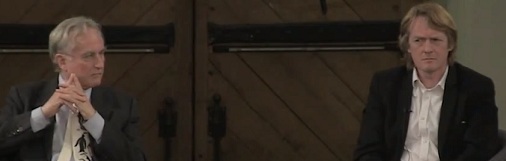
    The furrowed eyebrows of Stephen in that picture (and throughout the Q&A) you put up with the appropriate caption is also very revealing. Loved the discussion, but I’m afraid it might actually be necessary to spell out clearly the differences of science and religion and make clear why one provides justified true beliefs and the other does not.
    I am truly sad to see this kind of pseudoskepticism also in my everyday life, friends who’ve I’ve hoped would have even tried to think before asking such similar questions (like “How can we possibly know anything?”)

    • http://www.facebook.com/hugo.ganca Hugo Gança

      “How can we possibly know anything?” is actually a good philosophical question.
      How do you know you are not in the “Matrix” or a brain in a bottle? You either
      develop a measure of *faith*(that thing Dawkins finds so evil) in the
      reliability of your memory, your reasoning and your sensory data, or you become
      a Solipsist. Dealer’s choice.

      As for the differences between religion and science, while in principle they are fundamental,
      in practice, for the average Joe, they don’t exist. Just as any sufficiently
      advanced technology is indistinguishable from magic, any sufficiently arcane
      and rarefied finding comes to you as a revealed truth from on high. If you were
      to apply the “Duck” principle, you would find that science, for most people,
      walks like a duck, quacks like a duck, …

      • http://www.skepticink.com/incredulous Edward Clint

        I disagree. A “rarefied finding” in science has the capability of being publicly and openly contested on the basis of evidence, reason, and failure-to-replicate. Even for the average Joe, that is a profound difference from “the sky captain says so” which nobody anywhere (not just said Joe) can verify. Now that doesn’t make any one finding proven or not in a philosophically exacting sense, but it does make the output of science and of religion different kinds of products.

        • http://www.facebook.com/hugo.ganca Hugo Gança

          The outputs are very different, I do not contest that. What I do contest is the
          assertion that they SEEM different to the layman. “If you study hard and go to university for four years you will understand these matters” can sound uncannily like “if you pray hard and go to seminary for four years you will understand these matters”. “I know this is so, because my teacher/this scientist told me” is very like “I know it is true because my priest told me”. And a peer-review process that weeds out bad science or sloppy methodology can appear to be functionally identical to a Vatican court that weeds out Heresy. Whether the Truth comes from God or from The Universe, there is this class of intermediaries (priests or scientists) who interpret and disseminate it and whose word must be taken on
          faith unless you chose to join them. To be perfectly clear: I am not saying
          that science is a religion, or even that it functions as a religion. I AM
          saying that the way scientific knowledge comes to the public has many similarities to the way revealed religious dogma comes to the public, and that to the guy that cares as little for the Higgs Boson as he does for how many angels can dance on the head of a pin, it’s six of one, half a dozen of the other.

          • http://www.skepticink.com/incredulous Edward Clint

            I don’t at all sympathize with any lay person who knows so little about science, that it “seems” like religion. Science today is astoundingly accessible! Anyone can pour through history and science wiki pages, mingle with scientists on social websites. You can watch any of the hundreds of videos about science that have been produced; you can read any of thousands of books.

            You also can’t fail to notice 1) you’re on a computer. So, science works. It is effective. No faith needed. You’re using it right this instant. and 2) there is no central science authority. The Papal court used to execute people. The worst that can happen in science? A person writes a bad review. A journal rejects you (but you can submit your work to a hundred others).

            I do believe in good science communication to the public (here I am, after all), but you really need to have a dedicated and unwavering indolence to say “well it’s all the same to me, and certainly I can’t be expected to burn a calorie learning anything”.

          • http://www.facebook.com/hugo.ganca Hugo Gança

            Righteous indignation FTW. It is at moments like these that I can understand the knee-jerk reaction that I usually find so annoying to utter the phrase “Check your privilege”. Yes, you and I are using computers and if you and I were the only people on the planet, or even representative of the majority of people, your argument would be damned good. But as we are not, I would remind you that there are BILLIONS of people on the planet and that the
            idea that “ANYONE” can “mingle with scientists in social websites” is beyond ridiculous. (There are, in fact, many people that have insufficient food, water, shelter, not to mention a total lack of computers and internet connections, nor the education necessary to operate and understand them, and by many I mean billions). Even in modern industrialized western countries, there are vast swathes of the population that due to their age, lack of education or economic status do not share your familiarity with science. And as to dedicated and unwavering indolence”, try to find a reason why a guy that just spent 12 hours down a coal shaft might come home and prefer to drink a beer and watch a bit of the game on T.V. before he passes out on the couch and has to do the same thing tomorrow instead of the much more worthwhile and useful pursuit of learning quantum physics.

            And “the worst that can happen in science”? Again, I would ask that you imagine something. What do you suppose would happen to the author or a paper that supported Homeopathy, no matter how well thought out? Would she be getting grants and tenure and published in journals? Or would this contrarian view be laughed at, the author laughed out of science no matter the merits of the experiment? In case your imagination fails you, take a look at the history of science, you might find the answer there.

            To save you some calories:

            http://amasci.com/weird/vindac.html

          • Daniel Engblom

            I was sympathetic for a while with you pointing out how science can appear for disinterested people too busy to live their parochial lives.
            But this last passage of yours borders on the standard pseudoscientific rationalization, arguing about revolutionaries. I’m sorry but you commit a very sad error – Already by doing a bait-and-switch, as you add “–no matter the merits of the experiment?” Many sceptics and scientists DO go through their studies, almost always finding serious faults. And you’re leaving out one huge swatch that finally makes your entire point moot: Many pseudoscientists have their own “journals”. It’s not like they’re being suppressed, they can voice their beliefs, and there will always be scientists and sceptics willing to sift through the borderlands of science to either learn about human error or possible new discoveries. Other’s are too busy exploring the real universe.

            Yes, contrarians always have it tough, they have to make a case, they carry the burden of proof, and once – like in homeopathy – their claims contest some existing knowledge, not just, as in science, a hypothesis for the unknown, the larger the existing body of knowledge they contradict the larger their burden of proof.

            I make no apologies for this, this is science, live with it. It’s rational to keep the facts (up to a point!) and have standards for what is allowed under the same umbrella of justified true beliefs.

          • http://www.facebook.com/hugo.ganca Hugo Gança

            You miss the point. Perhaps I was not sufficiently clear, so let me rephrase.

            -Although there is no central authority in science, there is a science “mainstream” and a science “establishment.”
            -There are real world consequences to publishing results contrarian to the establishment science, that include loss of tenure, jobs and grants.
            -SOMETIMES the contrarian result is proven right (later).

            This was a response to Edward Clint’s question “what is the worst that can happen in science”. My answer is, you lose reputation money and perhaps your chosen career.

            You need not make any apologies for how science is conducted, I am reasonably certain it is not your fault. As for living with it I would much rather improve it where feasible, but that’s just me.

            There is, to me, a clear distinction between proving something wrong and dismissing it out of hand, and I much prefer the former.

            “Heavier-than-air flying machines are impossible”, Lord Kelvin, 1895.

          • http://www.skepticink.com/incredulous Edward Clint

            I’m an anthropologist, so let me ask you, who is the “mainstream” and establishment? Is it UCLA, my school, which has produced many influential scholars? Or is it east coast bastions like Harvard? What about England? Germany has excellent anthropologists and publications. Japan? Please tell me what central authority is setting the rules for everyone, I’d really love to know. I certainly don’t now.

            It is possible you can lose your career over doing controversial or unpopular research. However, I think this is quite often preventable by doing good science. For example, Napoleon Chagnon’s work was hugely subversive at the time, even though he did not intend it to be. He got lots of criticism. He defended his work, and kept his career. He recently joined the National Academy of Sciences.

            Conversely, in a religious court of opinion, evidence holds zero sway. Follow-up studies do not matter. In science, they do. Either way, you can still get screwed.. but the odds of being rewarded for good work are much, much higher in science. The numbers of martyrs, far fewer. The system is much more fair, and much more functional, even if it remains imperfect.

          • http://www.facebook.com/hugo.ganca Hugo Gança

            -There is no central authority.” Mainstream” would refer to all those influential scholars. To the stuff published in the “good” journals and stuff like it. If your stuff gets published in “Nature” or in the “New England journal of Medicine” you are probably mainstream.

            “The system is much more fair, and much more functional, even if it remains imperfect.”

            I do not contest this. I have stated in previous post the existence of fundamental differences between science and religion and what comes from either. My point was, and remains, that those differences are not immediately obvious to the uninformed and perhaps even uninterested layman.

          • kiiski

            The people who lack sufficient food and modern amenities are probably not generally the same ones that go around wondering “how can we possibly know anything?” or “what if we’re in the Matrix?” And I doubt that the guy who had just spent 12 hours down the coal shaft would be likely to appreciate the suggestion that his “faith” in the physical existence of the coal shaft is no better grounded than solipsism.

          • http://www.facebook.com/hugo.ganca Hugo Gança

            What people that lack food generally think a lot about is GETTING food. People that lacked modern amenities DID go around wondering “how can we possibly know anything” and came up with matrix-like thoughts. Although there was a notable lack of computers and internet connections, not to mention telephones, refrigerators running water and other modern amenities in Ancient Greece, It did manage to produce the likes of Plato, Aristotle, Socrates, Anaxagoras, Gorgias and a few more. Perhaps you have heard of some of them? Relatively poor people with shitty lives are not barred from having deep and interesting thoughts. I’ll freely grant you that most of them don’t, but them again most people that are rather well off don’t either.

            As for the coal miner’s appreciation of solipsism, that rather depends on the coal
            miner, but chances are he will take it about as well (or as badly) as the average
            banker.

          • kiiski

            I see, your anti-elitist stance only lasts as long as it’s useful to troll scientists with :D I never said poor people couldn’t think interesting thoughts (in fact I’d say most people do!), but physical labor likely does not predispose one to solipsism.

            You’re right that people did go around asking those questions before modern times (something of a goalpost move, though), but those people also were more likely than not to belong to relatively privileged groups of their time. Even a buddhist monk with his begging bowl relies on the existence of others who haven’t yet renounced the world.

            And despite millennia of platonic obfuscation, at bottom science does not require any more assumptions about reality (in some ways even less) than the average farmer or coal miner or baker needs to get through their day.

          • http://www.skepticink.com/incredulous Edward Clint

            I do not discount or forget the existence of those who live in poverty, but they are also people to whom this discussion does not apply. If you’re struggling to have adequate clean water, food, or shelter then scientific literacy is not really the priority; in other words, I could forgive such people for whatever misconceptions they have. This is a website, though, and our discussion is about communication of science to the public. That is necessarily constrained to the sector of the public to whom scientific understanding is relevant and possible.

            As for your coal mine worker, I do not fault them whatsoever for choosing to have a beer and watch TV before bed. However, you did specify industrialized western countries. Said person would have had to have a basic primary education and presuming that was effective at all, they should have a basic science literacy. If not, then the system failed them and should be corrected. If they just don’t care about science, fine. But then, one is not justified in making outlandish claims about things that they deliberately excised from their life.

            You might benefit from learning about the irrationality of CRT before you play the card to win an argument: http://www.skepticink.com/lateraltruth/2013/03/08/chuck-your-privilege/

            re: Homeopathy. Well that is demonstrably the domain of frauds and nonsense. That means a defense must not just be “thoughtful” but also bring real evidence to support it. In fact I don’t really understand how any would write a positive, thoughtful paper on a piece of pseudoscience without evidence in hand.

            The website you link isn’t too persuasive. I didn’t read all of it, but it lists as “reviled for [his] crackpottery” paleontologist Robert Bakker. Here’s what wiki says about Bakker:

            “…helped reshape modern theories about dinosaurs, particularly by adding support to the theory that some dinosaurs were endothermic (warm-blooded).[1]Along with his mentor John Ostrom, Bakker was responsible for initiating the ongoing “dinosaur renaissance” in paleontological studies, beginning with Bakker’s article “Dinosaur Renaissance”, Scientific American, April 1975. His special field is the ecological context and behavior of dinosaurs.

            Bakker has been a major proponent of the theory that dinosaurs were “warm-blooded”, smart, fast, and adaptable. He published his first paper on dinosaur endothermy in 1968. His seminal work, The Dinosaur Heresies, was published in 1986. He revealed the first evidence of parental care at nesting sites for Allosaurus. Bakker was among the advisors for the film Jurassic Park and for the 1992 PBS series, The Dinosaurs. He also observed evidence in support ofEldredge’s and Gould’s theory of punctuated equilibrium in dinosaur populations. Bakker currently serves as the Curator of Paleontology for the Houston Museum of Natural Science.”

            Bakker seems successful, acclaimed and beloved to me.

          • http://www.facebook.com/hugo.ganca Hugo Gança

            “…people to whom this discussion does not apply…”,”… to whom scientific understanding is relevant and possible….”

            It appears that the number of people to whom this discussion, in your view, does apply, is vanishingly small. Although for a largish number of people an understanding of science is certainly possible, that number is vastly reduced if you add “relevant”. The relevance to most people’s lives of Cosmology, Quantum Physics, Evolutionary Biology and a host of other subjects is nil.

            “…our discussion is about communication of science to the public…”

            If you believe so, then we are badly miscommunicating. I have been conducting this conversation under the impression that we were discussing the differences and similarities between science and religion, as seen by a layperson. I was lead to form this idea by your first post. (“I disagree. A rarified finding….”). What lead you to your conclusion?

            “… then the system failed them…”,”… not justified in making outlandish claims…”

            The “system” fails people constantly. In the U.S. there is, in some states, a desire to teach the “Creation Theory” in science classes. There are people who are homeschooled and are not part of a system at all. And whether or not they are justified in doing so, people can and often do have views on what science is and how it works.

            “You might benefit from learning about the irrationality of CRT before you play the card to win an argument: http://www.skepticink.com/late…”

            I am unclear on what “winning an argument” on the internet would look like. A thought-provoking debate and the opportunity to possibly learn something is what I usually seek. On close examination of what I actually wrote, you might find that I claimed to understand a reaction, and did not, in fact “play a card”. You might also benefit from scrolling down the comment section of the page you linked to, and finding my comments about the subject. You will find that I am not entirely unaware of CRT’s irrationality.

            “Homeopathy. Well that is demonstrably the domain of frauds and nonsense”.

            The reason I chose Homeopathy as my example is exactly the perception of it. It is necessary to demonstrate that it is nonsense, no matter what you heard about it beforehand. And should a researcher ever find evidence that even slightly vindicates it, they would fear releasing the findings for fear of been tarred as a “fraud”.

            “The website you link isn’t too persuasive. I didn’t read all of it….”

            The link was intended as a starting point only, I apologize if that was unclear. In any case, when investigating a matter, it is often useful to get past the “B’s”
            before forming an opinion. Had you gotten to Goddard, for example, you might have found this on his wiki page:

            “Although his work in the field was revolutionary, Goddard received little public support for his research. Press sometimes ridiculed his theories of spaceflight. As a result, he became protective of his privacy and his work. Years after his death, at the dawn of the Space Age, he came to be recognized as one of the founding fathers of modern rocketry.[8][9][10] He was the first not only to recognize the scientific potential of missiles andspace travel but also to bring about the design and construction of the rockets needed to implement those ideas.[11]”

      • Daniel Engblom

        I apologise, when I mentioned people asking similar questions like “How can we possibly know anything?”, I implied but did not spell out, that people usually ask this in a dishonest manner, never expecting any answers but trying to end people asking them for reasons or evidence for their claims.
        Just to nitpick, for instance, there is actually rational reasons to give less weight to the Matrix versus this being it: Parsimony. The Matrix and its equivalents of illusory reality hypotheses do not explain anything more than the realism option does, plus makes the extra assumption without justification that there’s something more, like the Matrix or brain in jar.
        I agree with what Ed wrote to your last point, you don’t take into account that one can question and seek for the evidence and justification underlying those findings, whereas religion lacks any standards to sort unjustified claims from the rest.

        • http://www.facebook.com/hugo.ganca Hugo Gança

          “…usually ask this in a dishonest manner… “I guess I missed that nuance, my
          bad.

          As for your
          “parsimony” argument, well yes, there are rational reasons to contest “The
          Matrix”. There is really no good reason to assume that this is the case. The
          fun thing is, parsimony notwithstanding, that it is an irrefutable hypothesis.
          There is, to my knowledge, no way to prove that you are NOT a brain in a jar. Just
          for fun and in case it tickles your fancy: http://www.simulation-argument.com/simulation.html

          I addressed
          the Science/Religion angle in a response to Ed, please see above.

          • Daniel Engblom

            Well yes, it is irrefutable, I’ve been told that on many occasions, but I feel that people too often confuse “irrefutable” with “reasonable”: Just because one can elaborate complex hypothetical scenarios, doesn’t make them respectable. Scientists and respectable philosophers need to raise consciousness on the fact that Realism (at least a modest form), is much more rational, justified, than the available ill-defined matrix-options.

            This is indeed very much related to the typical trope of “you can’t prove a negative”. You clearly say, “–no way to prove that you are NOT a brain in a jar.” And this is logically equivalent to the usual suspects in debates about the non-existence of god(s). And here I hope you can remind yourself of all the answers given by such people as Bertrand Russell or Victor Stenger.

          • http://www.facebook.com/hugo.ganca Hugo Gança

            About “you can’t prove a negative”, sit back and see me prove there is no elephant in my back pocket.

  • Clare45

    Wycliff Hall (not part of the University) is an Evangelical Christian college in Oxford. This could explain some of the questioners.

    • http://www.skepticink.com/incredulous Edward Clint

      Ah. Thanks, Clare.

  • David Brunton

    I think the single best moment of that was when Dawkins said “Science works, bitches”. There’s something wonderful about that classic british voice quoting a webcomic.